
When considering orthodontic treatment, the first big question is often the same: Invisalign or braces?
Both options can produce excellent results, but they are not suitable for the same needs. Your choice depends mainly on the complexity of your case, your lifestyle, and your priorities (discretion, comfort, speed, budget).
At Clinique Orthodontie Côte-des-Neiges, we evaluate each situation with a simple goal in mind: to choose the most reliable solution for achieving a straight smile… and stable occlusion.
The essentials in 30 seconds
- Invisalign is ideal if you are looking for a discreet solution and your case is mild to moderate (or compatible with aligners).
- Braces remain the gold standard for complex corrections and tooth movements that require maximum control.
- The “best choice” is not a brand: it is the treatment that suits your teeth, your bite, and your goals.
- An orthodontic consultation is essential: we don’t choose based on “feelings,” we choose based on a diagnosis.
Invisalign and braces: what is the difference in practical terms?
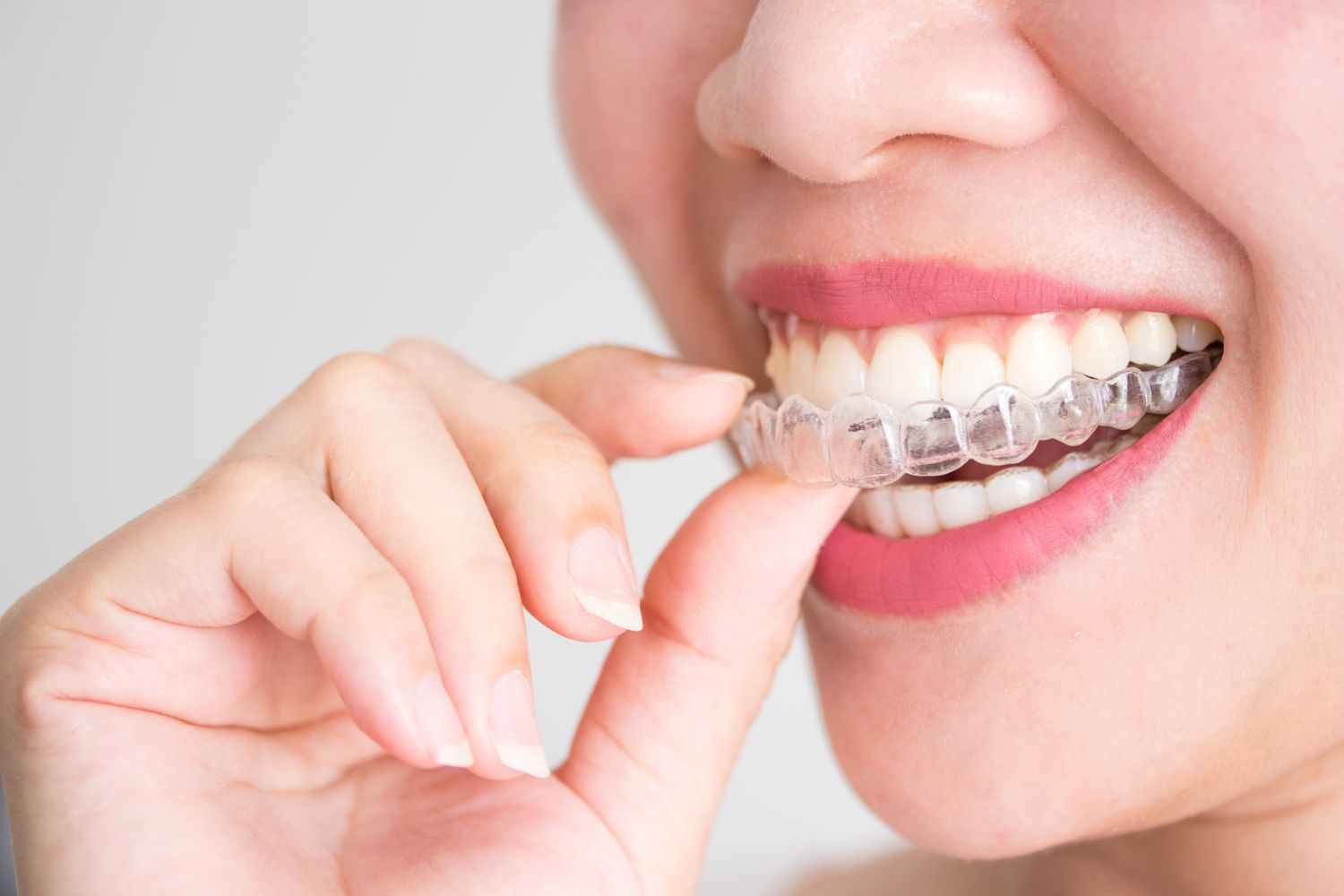
Invisalign: transparent, removable aligners
Invisalign is based on a series of custom-made transparent aligners. They gradually move the teeth, step by step. The main advantage is discretion… but the real game changer is flexibility: you can remove the aligners to eat and brush your teeth.
Braces: a fixed, ultra-precise device
Braces use brackets bonded to the teeth, connected by orthodontic wire. They are fixed, so they work continuously. This is a very robust solution, particularly useful when tooth movements are more demanding (rotation, verticality, occlusion, etc.).
Why shouldn’t the same patient choose the same option as their friend?
Because it’s not a matter of preference: it’s a matter of orthodontic control.
Two smiles may “look” similar, but behind them there may be:
- a different bite,
- asymmetry,
- unstable dental contacts,
- or a lack of space that completely changes the treatment plan.
This is exactly why we insist on a complete examination before making a decision.
Invisalign: who is it best suited for?
Invisalign is often an excellent choice if discretion is your priority, particularly in a professional or social context. It is also highly appreciated when you want to maintain a simple hygiene routine (brushing, flossing) without the constraints of fixed braces.
In practice, Invisalign is frequently suitable for:
- adults,
- mild to moderate cases,
- and patients who are able to be rigorous (wearing them 20-22 hours a day).
The key point: Invisalign can be very effective… if the protocol is followed.
Braces: when they are clearly preferable
Braces remain extremely relevant, and sometimes the best option.
They are often recommended when:
- the correction requires complex tooth movements,
- the occlusion is unstable and must be corrected very precisely,
- or when you want to avoid dependence on the “disciplined” wearing of a removable appliance.
It is also a common option for teenagers: it is fixed, so there is no risk of aligners being forgotten.
Invisalign or braces: how to choose based on your profile?
If you are an adult in Montreal
If discretion is an important factor, Invisalign is often considered first.
But the final decision depends on what needs to be corrected: simple alignment, crowding, gaps, slight bite… or more extensive correction.
If it’s for a teenager
Braces are often preferred for their effectiveness and continuity (they work all the time).
That said, some highly motivated teenagers may be good candidates for aligners.
If your case is more complex
Sometimes it can be treated with Invisalign, sometimes not, and sometimes by combining approaches.
What matters is achieving a stable result, not just “straight teeth in a photo.”
Does Invisalign work for everyone?
No, and it’s good news that we can say that clearly.
Invisalign is excellent, but some cases require the level of control that fixed braces provide more easily (depending on the diagnosis).
A consultation is designed to answer this question with objective information:
- bite analysis,
- necessary movements,
- risk of relapse,
- stability of results.
Duration: what is the fastest option?
There is no rule that says “Invisalign = fast” or “braces = long.”
The duration depends mainly on:
- the starting point (complexity),
- biology (tissue response),
- and the regularity of treatment.
Often, mild cases are treated more quickly, regardless of the method.
Conversely, a complex case may take longer, even with the most “effective” option.
Prices in Montreal: How much does Invisalign or braces cost?
The cost of orthodontic treatment varies depending on:
- the complexity of the case,
- the duration of follow-up,
- the appliance chosen,
- and sometimes additional steps.
In Montreal, Invisalign and braces are often in comparable price ranges, but the only true price is that of the personalized treatment plan after evaluation.
How to make the right decision?
The right choice is the one that allows for:
- a harmonious smile,
- a functional bite,
- long-lasting results,
- and a daily routine that fits your lifestyle.
This is exactly what we validate during your consultation: you leave with a clear recommendation and a realistic vision of the process.
Need an orthodontic opinion in Montreal?
At Clinique Orthodontie Côte-des-Neiges, we offer Invisalign and fixed braces, with personalized support from start to finish.
If you’re unsure whether to choose Invisalign or braces, the easiest thing to do is discuss it during a consultation: we’ll tell you which option is best for you and why.